


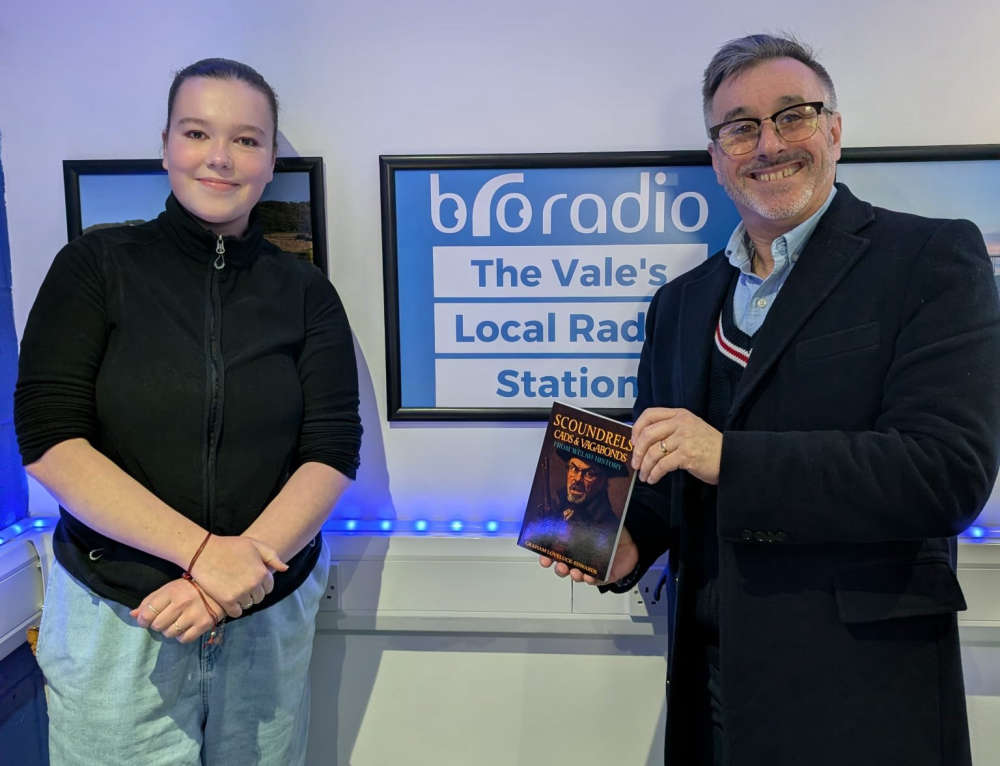
Local Author and historian Graham Loveluck-Edwards visited Bro Radio to discuss his new book tour, local folk law, and which Welsh bad guy you wouldn't want to meet the family.
It’s immediately clear when talking to Graham, that he simply lives and breathes history, helped by his gift for storytelling.
You may be familiar with his book “Historic Pubs of Wales”, or perhaps you’ve seen him feature as a guest expert on ITV’s “Vanished Wales”, or BBC’s “Sunday Morning Live” and host of Bro Radio's monthly “History on your doorstep”.
This time, however, Graham has turned his attention to the “scallywags”, the wrong ‘uns of Welsh history. As he explained;
“I'm always finding bad guys. So whenever I'm doing any historical research for any number of different reasons, at some point, and it doesn't matter what it is, at some point I will find some absolute villain who cheated, murdered and swindled their way into the story. And then when I kind of report back on what it was I was researching, they are always the most interesting bit. That's always the moment where people sit forward in their chairs and pay attention because there's a little bit of all of us that is fascinated by other people behaving really badly. It's like we can't get enough of it.”
“So I thought, well, as I have this back catalogue of absolute scoundrels, and here's a word you don't hear often, scallywags, I thought I'd put them all into one book. So I put them into sort of categories of people from the medieval period, industrialists, pirates, highwaymen, and just wrote about their audacious behaviour and the reputations that they've ended up with as a result.”
So who, you might ask, would Graham award the title of worse bad guy in Welsh history to?
“Cap Cork, who was a highwayman based near Bridgend.”
“Cap Corch was the landlord of the New Inn. Now this is in the 18th century, New Inn Road used to be the main road, basically from London to Carmarthen. And the stagecoaches would come trundling along and it was a really busy inn. And what Cap Cork used to do was sneak around the bedrooms of his guests late at night, slit their throats, rob them and then dump their bodies in the River Ogmore next door. The River Ogmore's got some really peculiar currents, so the bodies would get down as far as Ogmore by sea and then wouldn't go any further. They'd just sort of hover around the estuary. So people started to get suspicious as to what was going on. So realising he might get, because there's no police, 1830s when the police first came. So there's no police investigating stuff in these days, but he realises, you know, he's on thin ice here. So he changes his MO. Now as far as everyone else is concerned, whoever has been doing the killing has stopped. But alas, no.”
“It’s not until 80 years after his death, so he never faced the music for this, that the inn is no longer commercially viable. They knock it down because the main road now goes through Bridgend, not through Merthyr Mawr- and they find a cave and in it the effects, stolen effects from people who have been reported as missing. So they realise something's wrong. The Justice of the Peace says, “let's dig up around the inn to see what we can find” . And no sooner than they'd planted spade into soil, then they started finding grave after grave. Some of them with two or three skeletons in there. I mean, the man had been prolific. He's probably the worst serial killer in Welsh history. “
“…..they were still finding them in my own lifetime.”
Not a nice guy, then.
Accounts like this sound like stories; a topic Graham is well familiar with, having written extensively on Legends and Folk Law in the Vale of Glamorgan. He highlights the balance he strives to achieve with being honest to the origins of the tales, whilst acknowledging the sources may not, in fact, be first hand.
“The problem with a lot of Welsh history is that it wasn't captured by people who were there at the time. So the Victorians, for example, there was a brief period after the Mabinogion got translated into English when the English aristocracy fell head over heels with Welsh folklore and legend, in the same way that everyone in America fell in love with all things Australian when Crocodile Dundee came out. And that led to things like Tolkien coming here and getting inspired to write the Lord of the Rings series and all things like that. So in that moment, there was such a fascination with Welsh folklore, that a lot of things were written retrospectively and undoubtedly a lot of it was made-up.”
“Quite a lot of it comes from Bardic tradition. It comes, so for example, one of the stories I talk about is the beheading of Princess Gwenllian at the hands of Maurice De Londres in Kidwelly. And a lot of information we get about how people felt about this, what the reaction at the time was from the Welsh side of this argument, not the Norman side, comes from songs and poems that were written by the bards of the Kingdom of Gwynedd. And we perform the song. There's a beautiful song called “Llun Gwenllian” . And we perform that song as part of it. So you can see the full 360 view of how history gets to us”
“I let the magic creep in, but I always make it clear that this bit probably isn't true. So I let people decide for themselves.”
Finally, we’ll leave you with Graham’s advice for those wishing to discover (or perhaps rediscover!) their love for the stories that history has to offer.
“Get into it. Do it. Get out there. There's so much. I mean, the thing is, it's got to be stuff you can relate to. I mean, a lot of people say to me, “oh, when I was at school, I was never interested in history, but now I really am.” And the difference is at school, they were being spoon-fed the Wars of the Roses or was the Reformation and it maybe wasn't something that interested them because history is everything that ever happened ever. There is going to be something in there that's interesting to you.”
 Barry Arts Festival returns with Waldo play
 Gwen the polar bear visits the Memo
 More than 40 organisations set to showcase their volunteering opportunities in 2026
 New Community Cinema to launch in Llantwit Major
 Bro Radio Stars Step Into the Spotlight for Festive Pantomime