

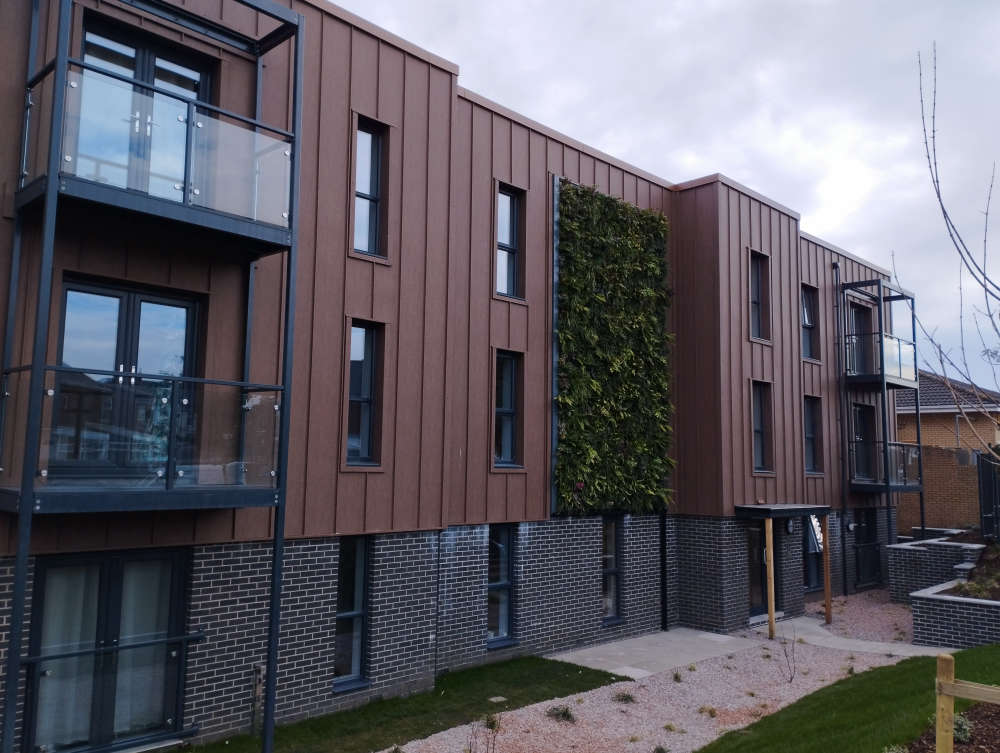
Rents for council housing in the Vale of Glamorgan are set to go up by more than 4% next year.
Councillors voted on Monday to increase rent by an average of 4.3%, which is the maximum rise allowed by the Welsh Government for the next financial year.
Vale of Glamorgan Council also agreed to the levels of service charges for things like grounds maintenance, cleaning of communal areas, lighting of communal areas, laundry facilities, window cleaning, lift maintenance, door entry, intercom, CCTV, sewerage treatment plants and cesspools with some increasing and others decreasing.
The council says the proposal reflects the current financial situation, with high interest rates and inflationary cost pressures in delivering current priorities and commitments.
They also pledged to deliver their ongoing ambitions to build new council housing at pace and scale and decarbonise the council housing stock by 2040, ensuring funding is available to meet the requirements of the new Welsh Housing Quality Standard (WHQS).
Analysis shows an extra £70 million will need to be invested in existing council homes in the next 10 to 15 years to bring them up to the WHQS (Welsh Housing Quality Standard), and £95 million is required over the next 30 years to directly respond to decarbonisation.
A council report says this capital investment is only possible if sufficient income is received through rents.
As well as spending on existing stock, the local athority spends its rental income to build new council homes, the report says.
There are huge pressures on existing social housing, with more than 7,600 households on the housing waiting list and more than 300 homeless people living in temporary accommodation.
The report adds says additional council housing “is the only way that we can end homelessness and ensure that households have a safe, secure, affordable home”.
In 2025-26, the council’s housing development team will have completed 61 new homes across three sites in Barry and construction will continue or start on a further five sites which will deliver a further 241 homes.
The report says: “Lower increases in rents have a significant financial impact on the housing business plan and threaten the council’s ability to maintain, improve and build new homes.”
The basis for rent increases is set by the Welsh Government policy for social housing rents, and in order to comply with the rent policy, social landlords must ensure their average weekly rents for their general needs and sheltered housing provides value for money and affordability to tenants.
Comparison of rents with other landlords is carried out annually and shows council rents for three-bedroom homes are 37% lower than private rents for comparable properties and 20% below the local housing allowance for the Vale of Glamorgan.
The difference for smaller properties such as one-bed flats is smaller, with council rents being 28% lower than private rents and 6% below the local housing allowance rate, although there are currently no properties of this type available in the Vale of Glamorgan to rent at the local housing allowance rate.
The report said council rents also remain less than the average housing association rent for the area.
It adds the council’s housing income team supports tenants to pay their rent and specialist money advisers assist with budgeting advice, claiming benefits, income maximisation and securing grants and other support.
The Welsh Government recently announced the social rent settlement for 2026-27, alongside a package of support for social tenants who are struggling financially.
Cllr Ian Johnson, who leads the Plaid Cymru group on Vale of Glamorgan Council, said there is a complication with people paying in for many years and paying more than is needed for the council to build more homes.
He said he understood the argument on a social level, but on an individual level it becomes much more difficult to justify.
Cllr Johnson added: “I do support the council’s plan to build a significant number of council houses here in the Vale. I welcome the changes put forward by Welsh Government considering the substantial impact of inflation on tenants.”
This change involves a 0.5% CPI ceiling as opposed to the previous 2.1% but he said it’s still unfair perhaps because it uses an inflation metric which differs substantially from the true expenditure which is needed year on year.
Cllr Johnson said he understands why the council is asking for the maximum increase allowed by Welsh Government and that a lot of tenants aren’t paying a very large rent but added: “It still strikes me as unfair that it’s the people footing the bill for this and we are not sure what sort of situation they are facing.”
Cllr Mark Wilson, the cabinet member for neighbourhood and building services, accepted that if they were mortgages they would have been paid off but added that if you’re an owner you pay for repairs.
He said the building services department pays for repairs in council housing and that the rent helps pay off those repairs.
Cllr Wilson said: “We do it in a very efficient and speedy manor” adding “I am very proud of building services and what they do.”
He added rental levels are very low and lower than other registered social landlords in the area, adding it’s “very laudable and that’s something I will continue to support.”
He said the housing revenue account has to be resilient and sustainable for the future.
Cllr George Carroll, leader of the Conservative group, said it was important that fairness and equity are the principles behind decisions they take on setting council rents.
He said there had clearly been increases in costs to the council of providing accommodation including CPI inflation which is up on the past year.
He added: “I think it is reasonable to increase the rents to take account of that but from a personal point of view I am uncomfortable with the idea of increasing rents at a rate above inflation.”
Cllr Carroll said when he looks at council tax he approaches it thinking they should freeze it in real terms so it increases by the CPI rate of inflation and he thinks that should be the approach on this matter and that he would be opposing the proposed increase.
The changes are due to come in from April 2026, with the first week of April being a non-chargeable rent week. Increase notices will be sent to tenants two months in advance of the new charges coming into effect.
 Barry Rugby Football Club has lodged plans for extensions to its clubhouse and other works
 Council Tax in the Vale set to increase by 6.5%
 Plans scrapped for new boat depot on Cardiff Bay peninsula
 Llantwit Major hosts week-long Peace Festival
 Local residents in Cowbridge have banded together to buy a beloved piece of land
 Welsh legend Max Boyce and record-breaking footballer Jess Fishlock honoured at St David Awards
 New care home could be coming to Barry is council approves plans
 50+ Forum Radio Show highlight by World Health Organisation as leading age-friendly initiative
 “Long-established rural enterprise hub” has applied for retrospective use of a base to provide services to the “wider rural community”.
 Vale Council named Employer of the year for Apprenticeships
 Average Vale House Price rises to £300,000
 Penarth Library shortlisted for Library of the Year Award
 Keep Wales Tidy launch "Drive your litter home" campaign
 Members return to the Senedd Siambr following redevelopment
 Barry resident shares his story of Operation Pied Piper in new book
 Council to engage with public over future of former Wilko Superstore in Barry
 Former Conservative turn Reform candidate wins Penarth By-election