

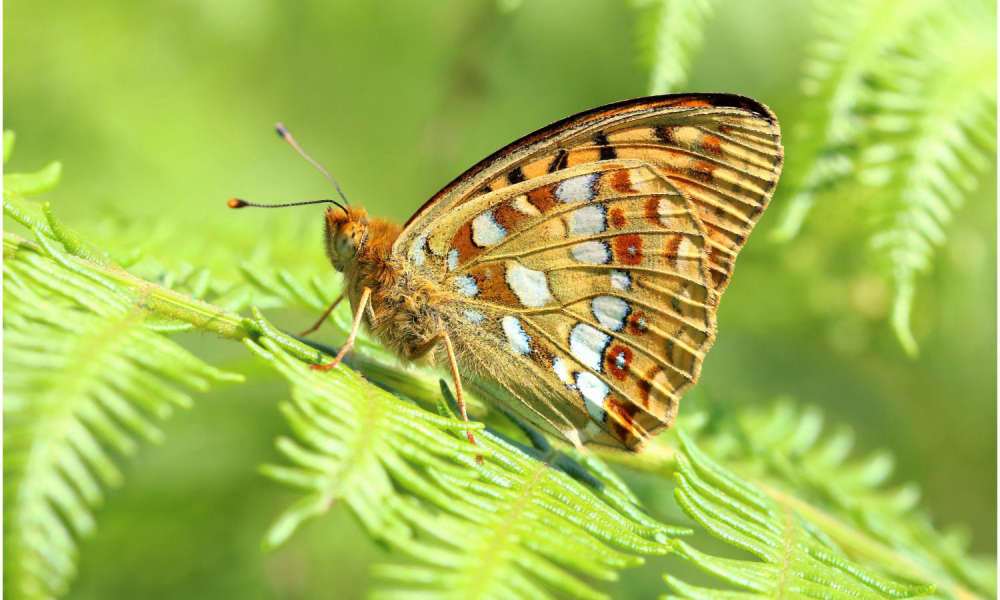
An exciting increase in the number of rare butterfly eggs in some areas in South Wales has been reported this month.
Changes in the way their habitat is maintained, alongside efforts to raise awareness have resulted in a 50% increase in the Brown Hairstreak Butterfly in protected areas West of Llandeilo, according to the Butterfly Conservation group.
In the Vale of Glamorgan, however, the story of the High Brown Fritillary Butterfly is of particular interest. I spoke with Dot, the High Brown Fritillary Project Officer, to find out more.
“Back in the very late 1990s, there were some volunteers who'd been recording the butterfly, and they only found seven that year.”
“Seven in the whole of the season. And the butterfly, I mean, flies in June and July.”
“They decided that they would take action. And they've got a group of volunteers together, only a small group initially, and some of those people are still volunteering now, nearly 30 years later.”
“What they have been doing is habitat management in the winter, which means coppicing trees and clearing paths through bracken.”
After the weather led to a dire year in 2024, the group has thankfully noticed an increase; 2025 was their 4th best year in the last 10 years.
“Old Castle Down and the area around it where the High Brown Fritillary lives, and of course it is the only place in the whole of Wales where it lives, is actually probably the best place in the whole of Wales to see a wide range of butterflies.”
“During June and July, a group of volunteers that go out to count the High Brown Fritillaries, they walk certain paths consecutively for five weeks. And I was on one of the walks one day, and we saw 19 species of butterfly [and] three species of dayfly moths in half a mile.
So it's a very special place and I don't think many people in the Vale of Glamorgan actually realise what they actually have on their doorstep. It is really, really wonderful.”
“And Butterflies are a really good indicator of things like climate change they're very sensitive creatures, so any, kind of small change in environments can actually be really problematic for them. And if they are going, what else is going?”
Whilst the High Brown Fritillary favours specialist conditions, if you have a garden it can be a fantastic place to spot a variety of bugs and butterflies. Dot also highlighted some steps you can take to optimise the conditions for pollinators.
“There's lots of things you can do in your own garden and the main one is planting the right plants. A lot of people have this tendency these days to things like lovely looking bedding plants, all these modern plants. The reality is they're not very good for pollinators. When I go out to do talks with people, I often ask them to look at the old-fashioned plants.”
“So anything with open flowers is fantastic, but one of the best ones is herbs. Herbs are great because they're good for bees and butterflies and moths. Don't forget the moths. Moths are incredibly important pollinators.”
Dot gives the examples of oregano, chives, sage and rosemary- if you inspect the flowers up close, they’re the perfect shape for the fine proboscis of the pollinators.
She also suggests a new way to experience your garden; by listening to it.
“I'm listening to all the buzzing of the bees and bees and hover flies and things like that there. And it's quite exciting. So what we can do in our own gardens is think a little bit differently.
It doesn't have to be expensive. You could buy a cheap packet of seeds with things like calendula, cornflowers, mallows, those kinds of things. You can just put that into a bed. They are lovely. They could flower all season and they will self-seed.”
The volunteer group in the Vale of Glamorgan is active all year round, including activities for children and families.
“In the winter, from October right through till mid-March, there's a very active group of volunteers out every Sunday morning, apart from when it's pouring with rain or heavy snow, they are doing habitat management.”
“So they're involved with coppicing trees and managing some of the bracken and having good fun actually. Some volunteers start at 8:30 on a Sunday morning, which is a bit early for some people, but others come along a bit later. “
“There are occasional bonfires. A lot of what is taken down is kept and creates habitat piles for fungi and invertebrates, so insects and things like that. But sometimes there's too much that's cut down and it has to be burnt.”
The volunteers practise a traditional way of managing woodland known as Coppicing. It doesn’t kill the trees, instead encouraging bio-diversity and regrowth.
The difference the Coppicing makes, alongside violet growth, is then monitored by volunteers in April.
“The butterfly only flies June and July. So every year for five weeks in a row, there's a group of volunteers that walks 6 different routes, counting butterflies. So there's opportunity for people to come out and count the High Brown Fritillary and other butterflies, that's the High Brown project, but there's also opportunity to walk other what we call “transects” in the Vale of Glamorgan and count butterflies during the summer months.”
“I go out and I'm involved with running events. So I take part in the Vale of Glamorgan Nature Festival and things like that. And sometimes I'm looking for volunteers to come and work with me on the stand. We'll do activities with children, like making paper butterflies and just talking to them about butterflies, or take a moth trap along with me that I've caught moths in my garden and we explore the moths and then they come back home with me into my garden at night so they're not harmed. But it's really nice to have some people working, volunteers working alongside me doing that as well. And it's great to engage with families and kids.”
“You can contact me 07471 191669 and my e-mail is dwilliams@ butterfly-conservation.org”
Alternatively, you can find the work of the Butterfly Conservation at https://butterfly-conservation.org.
 Art Gallery in Barry celebrates International Women's Day 2026
 First stretch of National Forest for Wales launched at Porthkerry Country Park
 Cardiff ex-servicewoman backs charity campaign
 Vale Foodbank usage up by more than 26%
 Bro Radio’s Community Awards returns with new headline sponsor
 Barry Rugby Football Club has lodged plans for extensions to its clubhouse and other works
 Council Tax in the Vale set to increase by 6.5%
 Plans scrapped for new boat depot on Cardiff Bay peninsula
 Llantwit Major hosts week-long Peace Festival
 Local residents in Cowbridge have banded together to buy a beloved piece of land
 Welsh legend Max Boyce and record-breaking footballer Jess Fishlock honoured at St David Awards
 New care home could be coming to Barry is council approves plans
 50+ Forum Radio Show highlight by World Health Organisation as leading age-friendly initiative
 “Long-established rural enterprise hub” has applied for retrospective use of a base to provide services to the “wider rural community”.
 Vale Council named Employer of the year for Apprenticeships
 Average Vale House Price rises to £300,000
 Penarth Library shortlisted for Library of the Year Award